

Some athletes win titles while others change what their sport looks like. Carolina Marín belongs firmly in the second category.
Her story is not just about medals, but about mentality: competitiveness from childhood, an early departure from home, historic victories, devastating injuries, and a legacy that will be remembered for generations to come.
From flamenco to badminton
Marín’s introduction to badminton was accidental. She grew up in Huelva, Spain, surrounded by dance, friends, and everyday play.
A friend took her to the sports hall, and she was immediately struck by something unfamiliar.
“I was really impressed with this sport because I never knew it. I had never seen it before.”
At first, there was no sign of a future world champion.
“Actually I was really bad, I have to be honest.”
What stood out instead was her mentality:
“I’m really competitive. I don’t like to lose in any game with anyone.”
That trait would become the foundation of everything that followed.
A life-changing move at 14
At just 14 years old, she left her family to train in Madrid at Spain’s national center. It was a decision that changed everything.
Her parents struggled with it emotionally — her father cried during the journey home — but she saw it differently.
She asked for the opportunity because she did not know if it would come again.
For Marín, it was not about sacrifice, but about chance.
“I was really happy to be in the national center, to be with the best athletes in Spain.”
The coach who shaped her career
A central figure throughout her journey is her long-time coach Fernando Rivas.
He discovered her at a youth tournament and later brought her into the national setup in Madrid. Over time, their relationship grew far beyond sport.
She describes him as a father figure, psychologist, and friend — a presence that remained constant through nearly two decades of highs and lows, and over nearly 20 years, that bond deepened:
“He means everything to me. The word ‘thank you’ is not enough.”
Breaking through in Europe and the world
Her breakthrough came in 2014 with her first European Championship title, following a painful near-miss the year before.
That disappointment became motivation, and she returned stronger the following season.
Shortly after, she reached the global stage and won her first World Championship, a defining moment in her career.
At the time, she had never beaten a Chinese player, something she describes as a mental barrier she had to overcome.
Her mindset was simple: to be the best, she had to beat everyone, and after the big win she gained even more belief if her self.
“I felt really, really happy. I showed to myself that I can beat anyone.”
Olympic gold and national impact
The pinnacle came at the 2016 Olympic Games in Rio. 2016 Summer Olympics
Her approach was unusually direct: she did not hide her ambition. Her goal was gold — nothing else.
After losing the first game in the final, she fought back and eventually secured Olympic gold.
The moment the final point ended remains one she still watches today.
Back in Spain, the impact was immediate. Badminton became visible in a way it had never been before, and she became a national sporting reference.
“In a big in a big supermarket place they sold all their rackets and all the badminton nets, so it was amazing and I felt really happy that finally people know what badminton is. This is something I feel really proud of myself”
Injuries, grief, and the hardest years
After reaching the top, her career was interrupted by a series of major setbacks: ACL injuries, missed Olympic cycles, and the death of her father during the COVID period.
She spent long periods in hospitals and describes this phase as one of the most difficult of her life, not just professionally but personally.
At times, she felt completely mentally exhausted, yet she continued to return.
Not because it was easy — but because stopping never was an option to her.
“If I had thought that way (thinking about giving up), I would have retired years ago — not now. Of course, it was incredibly hard for me. I went through four or five really difficult years, not only as a player but also personally. Losing my dad during COVID was extremely tough. I spent three or four months at the hospital every single day, and mentally I was completely exhausted. I was knocked out.
But I still wanted to try, because my dad would never have wanted to see his daughter feeling sad or giving up. I wanted to keep fighting for him. Then, as you know, two months before the Tokyo Olympics, I suffered my second injury.”
The Paris Olympics
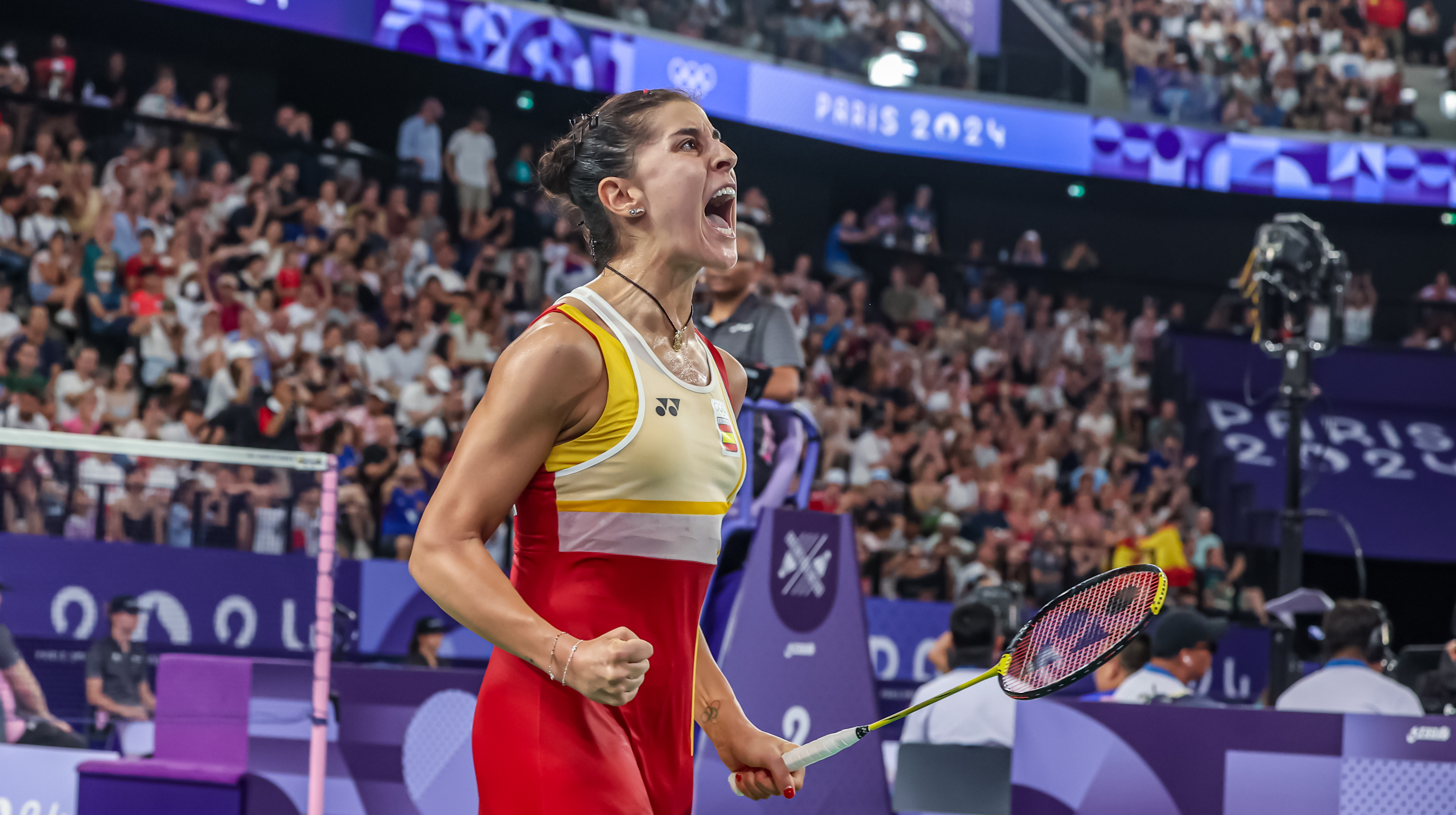
After years of injuries and setbacks, the Paris Olympics felt different for Carolina Marín.
She arrived in Paris believing she was back at her absolute best level, both physically and mentally.
“For Paris I was in my best for sure.”
There was a feeling that this was not simply another comeback. It was a real chance to win Olympic gold again.
And during the semifinal against China’s He Bingjiao, she looked on course to do exactly that. Marín had won the opening game and was leading comfortably in the second when disaster struck once more: another serious knee injury.
For Marín, the moment was difficult not only because of the injury itself, but because of everything that had come before it: two previous ACL injuries, years of rehabilitation, and the mental effort required to rebuild herself again and again.
“Why? Why to me?”
Back in the locker room, she reached an emotional breaking point.
“I told Fernando: I can’t anymore. I felt like this was the end.”
During rehabilitation after surgery, Marín slowly began thinking about whether she could return one final time. While recovering at, she found new motivation in the possibility of competing at the 2026 European Championships in her hometown.
“Why don’t you try one more time?”
That thought stayed with her. It became a new target and another reason to keep pushing through recovery.
In the end, however, reality caught up with ambition. After another surgery and careful reflection, she chose retirement over risking further damage to her body.
Retirement: a difficult but necessary decision
“It was the most difficult decision in my life, but at the same time the best.”
“If I have to choose between go again and maybe break my knee again, or just think in your health, because you are 32 years old and you have the rest of your life. And of course, I decided to think about my health and to think that I am still young. I have the rest of my life to do many things.”
At 32, she chose long-term health over the risk of further injury, acknowledging that her body needed care beyond elite sport.
Life after badminton
After years defined by training schedules, rehab, pressure, and constant competition, Marín is now stepping into a very different rhythm of life.
For the first time in a long time, she is not planning around tournaments or injuries. Instead, her focus has shifted to everyday life — family, travel, and simply being present.
She talks about this transition with a sense of relief, but also reflection. Life has moved fast for so long that slowing down feels almost unfamiliar.
“What is next is to enjoy right now the time with my family.”
She emphasizes that she wants to be close to the people who supported her throughout her career, especially after years where sport dictated almost everything.
“I want to spend more time with my family… I want to travel, I want to take vacation.”
But retirement does not mean a clean break from badminton. The sport is still part of her identity, even if she is no longer competing.
“Badminton gave me my life, and I gave badminton my whole life.”
For Marín, that relationship is not something she can simply switch off. Instead, she sees it as a lifelong connection — one that may evolve, but will not disappear.
“I cannot separate badminton from my life.”
She leaves the door open for future involvement, though without defining exactly in what form. For now, the focus is simply on living outside the demands of elite sport.
A message to the next generation
When asked what message she would give to young players who dream of following in her footsteps, Marín is very clear about one thing: she does not want them to copy her.
In fact, she actively pushes back against the idea of “the next Carolina Marín.”
“I don’t want a girl or boy to be the next Carolina Marín.”
For her, comparison is not helpful — neither for development nor for mindset. Every athlete has their own path, and trying to replicate someone else’s can create unnecessary pressure.
“Carolina Marín is only one person. They have to create their own way.”
This belief reflects how she sees long-term development in sport: individuality over imitation, and personal growth over external expectations.
But beyond structure and training philosophy, her message ultimately comes back to enjoyment.
“Enjoy what you are doing.”
She stresses that this applies not only to badminton, but to any path young people choose — whether sport, education, or something entirely different.
Carolina Marín – a fighter both on and off the court. A person who showed that it is possible to come from a small badminton nation and still reach the very top of the world through ambition, hard work, and dedication.
She is not leaving our sport behind, and now we simply have to wait and see where she will appear again.
Watch the whole Interview with Carolina Marin here.